
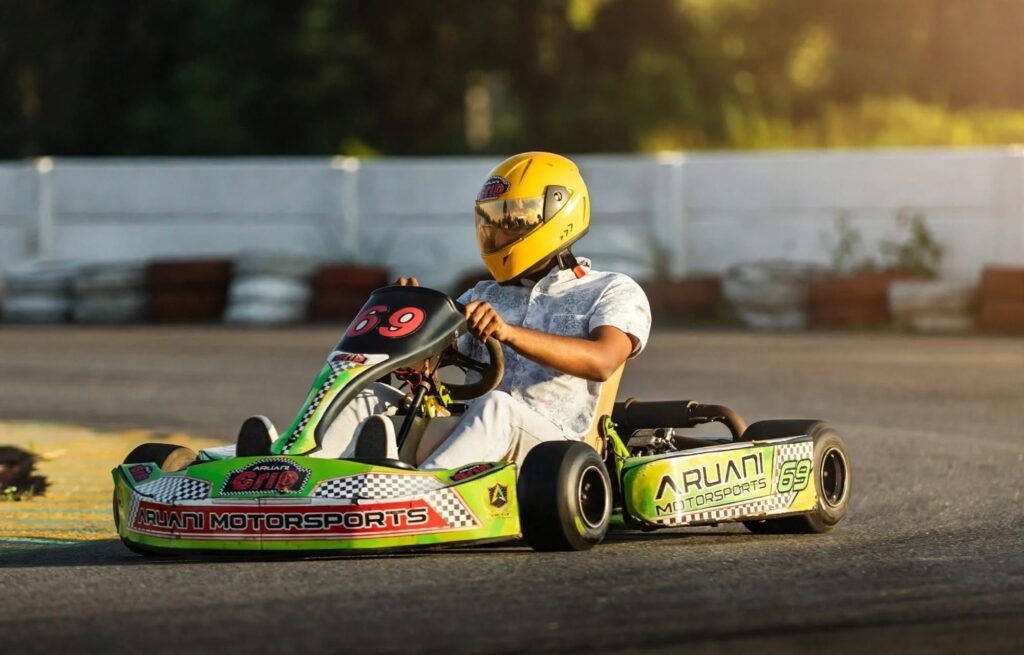
Being heavier than your competitors does not mean you cannot be faster on a go-kart track. Although additional driver weight can affect acceleration and braking, better racing lines, controlled braking, smooth steering and stronger corner exits can help heavier drivers compete more effectively against lighter racers.
The secret is not to drive more aggressively. It is to preserve momentum, minimise unnecessary speed loss and make every corner count.
If you are looking for practical go-karting tips for heavy drivers, this guide explains how to improve your braking techniques, master corner exits, choose better racing lines and develop a smarter racing strategy across different kart categories.
Whether you are driving a beginner-friendly 7HP kart, an intermediate 11HP kart or a high-performance 24HP racing kart, these techniques can help you become a more consistent driver.
1. How Does Driver Weight Affect Go-Kart Racing?
Driver weight affects a go-kart’s acceleration, braking and cornering behaviour because the engine and chassis must manage the combined weight of the kart and driver.
A heavier driver generally requires more energy to accelerate the same kart compared with a lighter driver. However, weight alone does not determine lap times. Driving technique, tyre grip, chassis setup, track conditions and consistency also influence performance.
Here is how additional weight can affect different aspects of karting:
| Racing Factor | Effect on Heavier Drivers | Recommended Approach |
|---|---|---|
| Acceleration | The kart may accelerate more slowly | Maintain momentum through corners |
| Braking | More total mass needs to be slowed | Use consistent braking points |
| Cornering | Changes tyre loading and chassis behaviour | Focus on smooth steering |
| Straight-line speed | May take longer to reach maximum speed | Prioritise corner exits |
| Grip | Additional load does not guarantee proportionally more grip | Adapt to actual kart handling |
| Race consistency | Smooth driving can reduce unnecessary speed loss | Repeat the same driving technique |
The key takeaway: Heavier drivers should focus on maintaining speed through the entire lap rather than trying to compensate for weight with aggressive braking or acceleration.
2. Master Braking Techniques Instead of Braking Too Late
Braking is one of the most important skills for heavier go-kart drivers.
Because additional mass creates greater momentum, approaching a corner too quickly and braking aggressively at the last moment can make it harder to control the kart. This can result in understeer, sliding or lost exit speed.
Instead of focusing on braking later than everyone else, concentrate on braking consistently and entering corners at a speed that allows you to accelerate efficiently.
Tip 1: Brake in a Straight Line
Approach the braking zone with the kart as straight and stable as possible.
Apply controlled brake pressure before turning into the corner. Avoid sudden steering movements while applying heavy braking, as the tyres have limited grip available to manage braking and cornering simultaneously.
A useful approach is:
-
Identify a fixed braking marker before the corner.
-
Release the accelerator smoothly.
-
Apply controlled braking while approaching the turn.
-
Reduce brake pressure as you begin turning.
-
Focus on reaching the apex without excessive speed loss.
The ideal braking point depends on the kart, track surface, grip and corner layout. Do not copy another driver’s braking marker without checking whether it works for your kart.
Tip 2: Avoid Locking the Wheels
Applying excessive brake pressure can cause the braking wheels to lock, depending on the kart’s braking system.
Wheel lock reduces the driver’s ability to control the kart and can lead to sliding or spinning.
Instead:
-
Apply progressive brake pressure.
-
Avoid stamping on the brake pedal.
-
Maintain a stable kart position.
-
Release the brake appropriately before applying more steering.
-
Follow the braking instructions provided by the track operator.
Remember that a controlled entry is usually more valuable than an unnecessarily aggressive braking attempt.
Tip 3: Understand When to Lift Instead of Brake
Not every corner requires heavy braking.
For medium-speed bends, a short throttle lift may be sufficient to reduce speed while maintaining momentum.
This technique is particularly useful in lower-powered recreational karts, where unnecessary braking can significantly affect acceleration out of a corner.
However, a throttle lift is not a replacement for braking when the corner requires substantial speed reduction.
Practical tip: Experiment with a small throttle lift on suitable bends and compare your lap times. Never sacrifice control to avoid using the brake.
3. Improve Corner Exit Speed to Beat Lighter Drivers
Corner exits are particularly important for heavier drivers because the speed gained or lost at the exit carries onto the following straight.
A lighter competitor might accelerate more quickly from a slow corner. Your opportunity is to minimise the speed you lose before reaching that acceleration phase.
Tip 4: Use a Late Apex for Better Acceleration
A late apex is a racing line where you approach the inside of a corner slightly later than you would with a conventional middle apex.
It can help you straighten the kart earlier and accelerate sooner when the corner leads onto a straight.
Follow these steps:
-
Position the kart appropriately before the turn.
-
Brake at a consistent reference point.
-
Avoid turning in too early.
-
Aim for a later clipping point where the corner layout allows it.
-
Begin applying throttle progressively as you pass the apex.
-
Unwind the steering and use the available track width safely.
A late apex is particularly useful for corners followed by longer straights.
It is not automatically the fastest line for every corner. In linked corners, the best line may require sacrificing the exit of one turn to improve positioning for the next.
Tip 5: Apply Throttle Smoothly and Earlier
One common mistake among amateur drivers is accelerating aggressively while the kart is still turning sharply.
This can cause tyre grip to break away and waste valuable speed.
Instead, progressively apply throttle as you unwind the steering wheel.
The goal is to reach full throttle as early as the available grip and corner geometry allow.
Remember:
-
Avoid sudden acceleration.
-
Reduce unnecessary steering input.
-
Focus on a clean corner exit.
-
Look ahead towards the next braking point.
-
Prioritise the corner that leads onto the longest straight.
A clean exit can be more valuable than gaining a small amount of speed at corner entry.
4. Choose the Right Racing Line Instead of Following Lighter Drivers
The racing line is the path a driver follows through a corner to maintain speed and control.
The conventional racing line involves entering from the outside, approaching the inside apex and allowing the kart to move towards the outside on exit.
However, the ideal line changes depending on corner shape, track width, traffic and the following section.
Tip 6: Avoid Unnecessary Steering Movements
Extra steering input can scrub speed and make the kart less efficient through corners.
Heavier drivers should pay particular attention to smooth steering because additional load can make mistakes more costly.
Try these techniques:
-
Keep your hands steady.
-
Avoid turning in too early.
-
Do not make repeated corrections through the corner.
-
Look towards the exit rather than directly at the front tyres.
-
Straighten the kart progressively as you leave the apex.
A smooth racing line is often faster than an aggressive line involving unnecessary corrections.
Tip 7: Understand When to Use a Tighter Line
A tighter line can sometimes help reduce the distance travelled through a corner or protect your position during a race.
However, taking a tighter line does not automatically make the kart faster. A smaller corner radius can require lower speed and increase steering demand.
Use a tighter line when:
-
You are defending a position cleanly.
-
The corner geometry supports a tighter approach.
-
A wider entry would compromise your next corner.
-
You can maintain a good exit without excessive steering.
When there is enough space and the corner leads onto a straight, a wider entry and later apex may produce a better result.
The objective is not to drive a shorter distance at any cost. It is to complete the corner with the best combination of speed, control and exit position.
5. Understand Different Kart Engine Categories
Not all go-karts behave the same way. Engine output, kart weight, braking systems, tyres and chassis setup all influence how a driver should approach a corner.
At Aruani Grid, drivers can experience different kart categories, including 7HP Matrix karts, 11HP Transformer karts and 24HP Rotax NFS karts.
Here is how heavier drivers can approach each category.
7HP Matrix Karts – Focus on Momentum
7HP karts are suited to beginner and recreational driving.
Because engine output is relatively modest, unnecessary braking and aggressive steering can make it difficult to regain speed.
Recommended techniques:
-
Avoid excessive braking on manageable bends.
-
Maintain smooth throttle inputs.
-
Focus on consistent corner entry.
-
Avoid unnecessary steering corrections.
-
Build momentum before entering the following straight.
Main priority: Preserve momentum rather than attempting aggressive overtaking manoeuvres.
11HP Transformer Karts – Focus on Corner Exits
11HP karts provide an opportunity for intermediate drivers to develop better racing techniques.
At this level, consistent braking, correct turn-in points and smooth throttle application become increasingly important.
Recommended techniques:
-
Identify braking points for individual corners.
-
Practise late-apex approaches where appropriate.
-
Avoid excessive steering angle.
-
Apply throttle progressively.
-
Compare corner exits using lap-time data.
Main priority: Improve corner rotation and acceleration without losing control.
24HP Rotax NFS Karts – Focus on Precision and Consistency
24HP Rotax NFS karts are designed for a more performance-oriented racing experience.
Higher engine output makes precise throttle control, braking discipline and steering inputs particularly important.
Heavier drivers should not assume additional weight creates an automatic grip advantage. Instead, understand how the kart responds to your driving inputs and adjust your approach accordingly.
Recommended techniques:
-
Establish consistent braking references.
-
Avoid carrying excessive speed into tight corners.
-
Focus on controlled corner entry.
-
Use progressive throttle application.
-
Minimise unnecessary steering movements.
-
Prioritise stability through faster sweeping sections.
Main priority: Combine precise braking, controlled cornering and strong acceleration.
6. How to Defend Your Position Against Lighter Drivers
Winning a karting race is not only about lap time. Racecraft, awareness and positioning also matter.
A lighter driver may have an acceleration advantage on a straight. However, you can make it more difficult for competitors to pass by maintaining a predictable and efficient racing line.
Try these techniques:
Protect the Inside Line
When defending a position, establish your line early and leave sufficient racing room. Do not make sudden movements to block another driver.
Focus on Corner Exits
If a competitor is close behind, concentrate on getting a clean exit. A strong exit can help you maintain speed and reduce the opportunity for an easy pass.
Avoid Unnecessary Battles
Repeated side-by-side racing can compromise both drivers’ lap times. Look for safe overtaking opportunities rather than forcing a pass into every corner.
Use Drafting Where Appropriate
When following another kart on a straight, reduced aerodynamic drag can help improve acceleration. Maintain a safe distance and overtake only when there is sufficient space.
Drive Predictably
Avoid weaving, contact and sudden defensive movements. Safe and consistent racecraft is more effective than risky blocking.
7. Common Mistakes Heavier Go-Kart Drivers Should Avoid
Even experienced drivers can lose valuable time through avoidable mistakes.
| Common Mistake | Why It Costs Time | Better Approach |
|---|---|---|
| Braking too late | Leads to excessive entry speed | Use consistent braking markers |
| Oversteering | Scrubs speed and affects stability | Use smooth steering inputs |
| Accelerating too early | Can cause grip loss | Apply progressive throttle |
| Copying lighter drivers | Their braking and acceleration references may not suit your kart | Develop your own reference points |
| Taking every corner tightly | Can compromise corner speed | Adapt the racing line to each corner |
| Looking only at the apex | Reduces awareness of the next section | Look towards the exit |
| Making sudden defensive moves | Creates unnecessary collision risks | Defend predictably and safely |
The biggest improvement often comes from correcting small mistakes consistently rather than trying advanced techniques immediately.
8. How to Improve Your Go-Kart Lap Times Using a 1 km Outdoor Circuit
Practising on a technical outdoor circuit gives drivers an opportunity to understand how different corner types affect overall lap performance.
Aruani Grid features a 1 km outdoor asphalt circuit with 14 technical turns near Dommasandra, off Sarjapur Road, Bengaluru.
Its combination of corners provides opportunities to practise braking consistency, steering control, corner exits and racing lines.
Here is a practical approach to improving your performance.
Step 1: Learn the Circuit
Complete your initial laps at a comfortable speed. Understand the corner sequences, braking zones and available track width.
Step 2: Identify Your Weak Corners
Pay attention to corners where you brake too early, enter too quickly or struggle to accelerate.
Step 3: Practise One Technique at a Time
For example, focus on smoother braking during one session and better corner exits during another.
Step 4: Monitor Your Lap Times
Use the digital transponder timing system to compare your performance across laps and sessions.
Step 5: Prioritise Consistency
Do not judge your progress using only your fastest lap. Compare several consecutive laps to identify whether your technique is improving.
Step 6: Make Small Adjustments
Change one braking reference or racing-line decision at a time. This helps you understand which adjustment actually improves your performance.
9. How to Know Whether Your Driving Technique Is Improving
Lap-time improvement is not always about achieving one exceptionally fast lap.
A better indicator is whether you can consistently reproduce good lap times.
Track these performance indicators:
| Performance Indicator | What to Monitor |
|---|---|
| Best lap time | Your fastest recorded lap |
| Average lap time | Your overall consistency |
| Lap-time variation | Difference between consecutive laps |
| Braking consistency | Whether you use repeatable braking references |
| Corner exit | Whether you can accelerate smoothly |
| Driving control | Whether you avoid unnecessary slides and corrections |
For example, if your fastest lap improves but your other laps become inconsistent, you may be relying on risky driving inputs rather than developing a repeatable technique.
Focus on becoming consistently faster, not just occasionally faster.
Frequently Asked Questions
1. Do lighter people go faster in go-karts?
Lighter drivers can have an acceleration advantage because the kart has less combined mass to move. However, driver weight is only one factor affecting lap times. Racing lines, braking, corner exits, driving consistency and kart setup also influence performance.
2. How can heavier drivers become faster in go-karting?
Heavier drivers should focus on maintaining momentum, using consistent braking points, avoiding excessive steering and improving corner exits. These techniques help reduce unnecessary speed loss and improve overall lap-time consistency.
3. What is the best cornering technique for heavier go-kart drivers?
A smooth corner entry followed by a controlled apex and progressive acceleration is a useful starting point. A late apex can also help when a corner leads onto a straight, allowing the driver to straighten the kart earlier and accelerate efficiently.
4. Should heavier drivers brake earlier in go-kart racing?
Not necessarily at every corner, but heavier drivers should account for the additional mass when selecting braking points. Consistent braking in a straight line is generally preferable to aggressive late braking that compromises corner entry and control.
5. Is it better to lift off the accelerator or use the brakes in go-karting?
It depends on the corner. A brief throttle lift may be sufficient for a medium-speed bend, while tighter corners may require controlled braking. Drivers should use the technique appropriate to the corner and kart.
6. Does body weight affect go-kart cornering grip?
Yes, body weight affects the load placed on the tyres and how the kart responds during cornering. However, additional weight does not guarantee additional usable grip because tyre behaviour and chassis characteristics also matter.
7. Which is more important in go-kart racing: corner entry or corner exit?
Both matter, but corner exit speed is especially important when the corner leads onto a long straight. A controlled entry and good exit can help maintain speed over a greater distance.
8. How can I improve my go-kart lap times?
Start by learning the circuit, identifying braking points, practising smooth steering and improving throttle application. Compare your lap times across multiple laps to understand whether your driving is becoming more consistent.
9. Can heavier adults participate in go-karting?
Adults of different body types can enjoy go-karting, provided they meet the venue’s applicable age, height, weight and safety requirements. Always check the specific kart category and track operator’s eligibility guidelines before driving.
Conclusion: Drive Smarter, Not Harder
Being a heavier driver does not automatically put you out of contention in go-kart racing. Although additional weight can affect acceleration and braking, better driving technique can help reduce the disadvantage.
Focus on three fundamentals: consistent braking, smooth cornering and strong corner exits. Practise these techniques, understand your kart’s handling characteristics and use lap-time data to measure your improvement.
At Aruani Grid, you can put your driving skills to the test on a 1 km outdoor circuit featuring 14 technical turns and experience different kart categories, from recreational 7HP Matrix karts to performance-oriented 24HP Rotax NFS karts.
Whether you are racing with friends, competing with colleagues or improving your personal lap times, every session is an opportunity to become a smarter and more consistent driver.
Ready to experience outdoor go-kart racing in Bengaluru?
Visit Aruani Grid near Dommasandra, off Sarjapur Road, and discover how much difference better driving technique can make.
Website: https://aruanigrid.com/


