
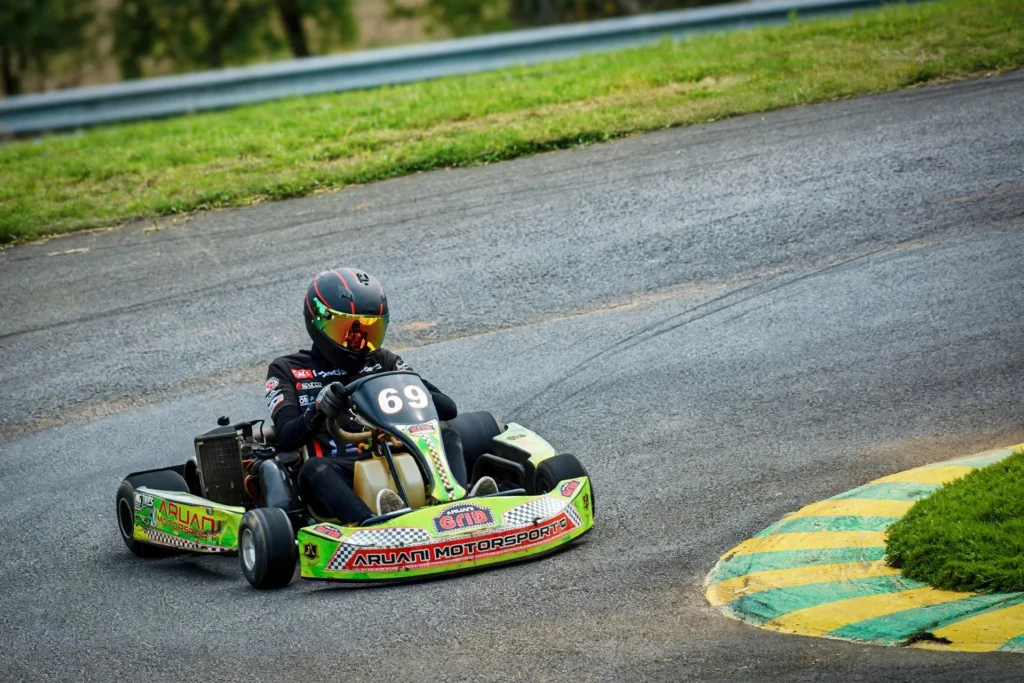
Driving a go-kart for the first time can feel exciting—and a little intimidating. The good news is that you don’t need professional racing experience to get started. Once you understand the controls, find the right driving position, and learn a few basic cornering and braking techniques, you can quickly become more comfortable on the track.
Whether you’re planning your first go-karting session or want to improve your lap times, this guide explains how to drive a go-kart, the mistakes beginners should avoid, and simple techniques that can help you drive more smoothly and confidently.
How Do You Drive a Go-Kart?
Driving a go-kart involves controlling three basic things: the accelerator, brake, and steering wheel. The key is to make smooth inputs instead of sudden movements.
For a beginner, the basic sequence is:
Sit correctly → Accelerate smoothly → Brake before corners → Turn smoothly → Hit the apex → Accelerate out of the corner
Before you start driving, always listen to the track briefing and follow the instructions given by the marshals.
1. Sit Correctly in the Go-Kart
Your driving position can make a significant difference to how comfortably you control the kart.
Sit with your back supported by the seat and make sure you can comfortably reach both pedals. Your knees should have a slight bend rather than being completely straight.
Keep your head up and look ahead toward where you want the kart to go.
Avoid leaning excessively forward or constantly moving around in the seat. A stable position helps you make more precise steering and pedal inputs.
Before starting, check:
- You can comfortably reach the accelerator and brake.
- You have a clear view of the track.
- Your back is supported by the seat.
- Your hands can comfortably reach the steering wheel.
- Your helmet and other required safety equipment are properly secured.
2. Learn the Go-Kart Controls
Most rental go-karts have two pedals and a steering wheel.
Accelerator
The accelerator controls the kart’s speed. Use it progressively rather than immediately pressing it to the maximum.
Brake
The brake slows the kart down. For most corners, braking should happen before you turn rather than while you’re already deep into the corner.
Steering Wheel
The steering wheel controls the direction of the kart. Keep both hands on the wheel and make smooth steering movements.
For beginners, a balanced 9-and-3 hand position is a good starting point.
One important rule is to avoid pressing the accelerator and brake simultaneously unless the kart or track operator specifically instructs you otherwise.
3. Start Slowly and Learn How the Kart Feels
When you leave the starting area, don’t immediately try to set your fastest lap.
Use the first few laps to understand:
- How quickly the kart accelerates
- How strongly it brakes
- How much steering input is required
- Where the corners are
- Where you should slow down
- Where you can safely accelerate
Every kart and every track can feel different. Give yourself time to understand the kart before pushing harder.
4. Look Ahead, Not Just at the Kart in Front
One common beginner mistake is staring directly at the kart ahead.
Instead, look further through the corner and toward the area where you want your kart to go.
Looking ahead gives you more time to prepare for:
- Braking zones
- Corners
- Traffic
- Changes in direction
- The exit of the corner
Your hands generally follow where your eyes are looking, so keeping your vision ahead can also help make your steering smoother.
5. Learn the Racing Line
One of the most important concepts in go-karting is the racing line.
A basic racing line follows an:
Outside → Inside → Outside
approach.
You normally approach a corner from the outside, turn toward the inside of the corner, reach the apex, and then allow the kart to move back toward the outside as you exit.
For example:
Approach → Brake → Turn in → Apex → Accelerate → Exit
The exact line depends on the shape of the corner and the track layout, so don’t assume every corner should be driven in exactly the same way.
6. Brake Before the Corner
Braking is one of the biggest areas where beginners can improve.
A common mistake is waiting too long to brake and then trying to slow down while already turning.
Instead, aim to do most of your braking while the kart is travelling relatively straight.
A simple beginner technique is:
Brake → Release → Turn → Apex → Accelerate
This helps you enter the corner with better control.
As you gain experience, you can gradually learn where your braking points are and how much speed you can carry through different corners.
7. How to Take a Corner in a Go-Kart
Cornering is where you can make a major difference to your lap time.
Start by positioning the kart appropriately before the corner. Brake in a controlled manner, then turn smoothly toward the apex.
Once you reach the apex, begin opening the steering and progressively apply the accelerator as the kart points toward the exit.
The goal isn’t simply to enter the corner as fast as possible.
A good corner exit is often more important than entering the corner aggressively.
If you carry too much speed into a corner, you may have to slow down more heavily during the turn and lose momentum on the following straight.
8. Accelerate Out of the Corner
Once the kart is pointing toward the exit, gradually increase the throttle.
Try to avoid suddenly applying full acceleration while the steering wheel is still heavily turned.
As the kart straightens, you can progressively use more throttle.
This is often described as:
Slow in, fast out.
The idea is to sacrifice a little entry speed when necessary so you can get a stronger and cleaner exit.
9. Don’t Drift Just Because It Looks Fast
Drifting can look impressive, but it isn’t usually the fastest way around a go-kart track.
When the rear of the kart slides, you can lose momentum and waste speed.
For most beginner and rental-kart situations, focus on:
- Smooth steering
- Controlled braking
- Good racing lines
- Strong corner exits
- Consistent throttle
Once you understand the basics, you can experiment with your driving technique under appropriate track conditions and instructions.
10. Use the Whole Track
Beginners often stay in the middle of the track without realizing that they are giving themselves less room to complete the corner efficiently.
Where track rules and conditions allow, using the available track width can help create a smoother racing line.
A basic corner might look like:
Outside entry → Inside apex → Outside exit
However, the ideal line changes depending on whether you’re approaching a hairpin, S-bend, chicane, or fast corner.
Don’t force the same technique onto every corner.
How to Drive a Go-Kart Faster
Once you’re comfortable controlling the kart, you can start working on lap-time improvement.
1. Improve Your Braking Points
Try to identify consistent braking points for each corner.
Don’t randomly brake at different locations every lap.
Consistency gives you a reference point that you can gradually adjust as your confidence improves.
2. Focus on Corner Exits
A clean exit can carry speed onto the next straight.
Instead of asking:
“How fast can I enter this corner?”
also ask:
“How quickly can I get back onto the accelerator?”
3. Smooth Out Your Steering
Rapid steering movements can make the kart unstable and cost momentum.
Aim for smooth and deliberate steering inputs.
4. Learn One Corner at a Time
If you’re trying to improve your lap time, don’t attempt to change everything at once.
Pick one corner.
Improve your braking.
Then improve your turn-in.
Then work on the exit.
Once you’ve improved that section, move on to the next.
5. Aim for Consistency
A single fast lap is exciting, but consistent laps are a better indication that you’re improving.
If your lap times are becoming more consistent, you’re developing better control of the kart and the track.
7 Common Go-Karting Mistakes Beginners Make
1. Braking Too Late
Waiting until the last possible moment can cause you to enter a corner too quickly.
Better approach: Find a consistent braking point and adjust it gradually.
2. Turning In Too Early
Turning toward the corner too soon can make it difficult to reach the correct exit line.
Better approach: Be patient with your turn-in and focus on the corner exit.
3. Accelerating Too Early
Applying too much throttle while the kart is still heavily turned can reduce control.
Better approach: Straighten the kart progressively and build throttle smoothly.
4. Steering Too Aggressively
Sudden steering movements can unsettle the kart.
Better approach: Make smooth, controlled steering inputs.
5. Looking Only at the Kart Ahead
Following another driver’s exact line doesn’t necessarily mean it’s the best line for you.
Better approach: Look ahead and focus on your own braking points and racing line.
6. Trying to Drift
Sliding the kart can look exciting but may slow you down.
Better approach: Prioritize grip, momentum and clean corner exits.
7. Trying to Go Fast Immediately
Your first lap isn’t the time to prove how fast you are.
Better approach: Learn the kart and track first, then gradually increase your pace.
Go-Kart Safety Tips for First-Time Drivers
Before getting on the track, pay attention to the safety briefing.
Always:
- Wear the required helmet and safety equipment.
- Follow the instructions from track marshals.
- Follow the track’s flag and signaling system.
- Maintain appropriate distance from other karts.
- Avoid intentional contact with other drivers.
- Don’t stop suddenly on the racing line.
- Follow overtaking instructions and track rules.
- Drive according to the conditions and your experience level.
Most importantly, remember that you’re sharing the circuit with other drivers. Being predictable and following the rules helps make the experience safer and more enjoyable for everyone.
What Should You Do During Your First Go-Karting Session?
If it’s your first time, don’t worry about setting the fastest lap immediately.
Your first few laps
Focus on learning:
- The track layout
- The kart’s acceleration
- The braking response
- The location of corners
- The racing line
Once you’re comfortable
Start working on:
- Consistent braking points
- Smooth turn-in
- Finding the apex
- Better corner exits
- Gradually increasing your speed
When you want to improve
Compare your laps and identify where you’re losing time.
Instead of trying to improve the entire lap at once, concentrate on individual corners and sections.
Ready to Try Go-Karting in Bangalore?
Reading about go-karting is only the first step. The best way to understand these techniques is to get behind the wheel and practice them on a real track.
At Aruani Grid, you can experience go-karting in a dedicated motorsport environment in Bangalore. Whether you’re getting into a kart for the first time or looking to improve your driving, each session gives you an opportunity to learn the track, understand the kart and become more confident behind the wheel.
Start with the basics, listen to the track briefing, focus on smooth driving and improve one lap at a time.
Ready to experience go-karting?
Book your go-karting session at Aruani Grid and put your new driving skills to the test.
Frequently Asked Questions About Driving a Go-Kart
How do you drive a go-kart for beginners?
Start by sitting correctly, learning the accelerator and brake, keeping both hands on the steering wheel and driving smoothly. Learn the track first before trying to increase your speed.
Is go-karting difficult for first-time drivers?
Go-karting is accessible to beginners, but controlling the kart smoothly takes practice. Your first session should focus on learning the controls, track layout, braking points and basic cornering.
Which pedal is the accelerator on a go-kart?
On many rental go-karts, the accelerator is the right pedal and the brake is the left pedal. Always follow the instructions provided by the track operator because kart controls can vary.
How do you drive a go-kart fast?
Focus on smooth braking, a good racing line, controlled corner entry and strong corner exits. Avoid unnecessary drifting and work on becoming consistent before trying to drive aggressively.
Should you drift a go-kart?
Drifting generally isn’t the fastest technique for normal track driving. Excessive sliding can reduce momentum and make it harder to maintain an efficient racing line.
How do you take corners in a go-kart?
A basic technique is to approach from the outside, brake before the corner, turn toward the apex and accelerate progressively as you exit. The ideal line depends on the specific corner and track.
Do you need to know how to drive a car before go-karting?
You don’t necessarily need car-driving experience to try go-karting, but you should meet the track’s age, height and other safety requirements. Beginners should always follow the operator’s instructions before driving.
Can beginners go-kart at Aruani Grid?
Yes, beginners can experience go-karting at Aruani Grid, subject to the facility’s current karting requirements and safety rules. First-time drivers should follow the briefing and instructions provided by the track team.
Final Tip for First-Time Go-Kart Drivers
Don’t worry about being the fastest person on your first session.
Learn the kart.
Learn the track.
Brake smoothly.
Look ahead.
Find your racing line.
And most importantly, enjoy the experience.
With practice, those first few laps can turn into faster, smoother and more confident driving.


