
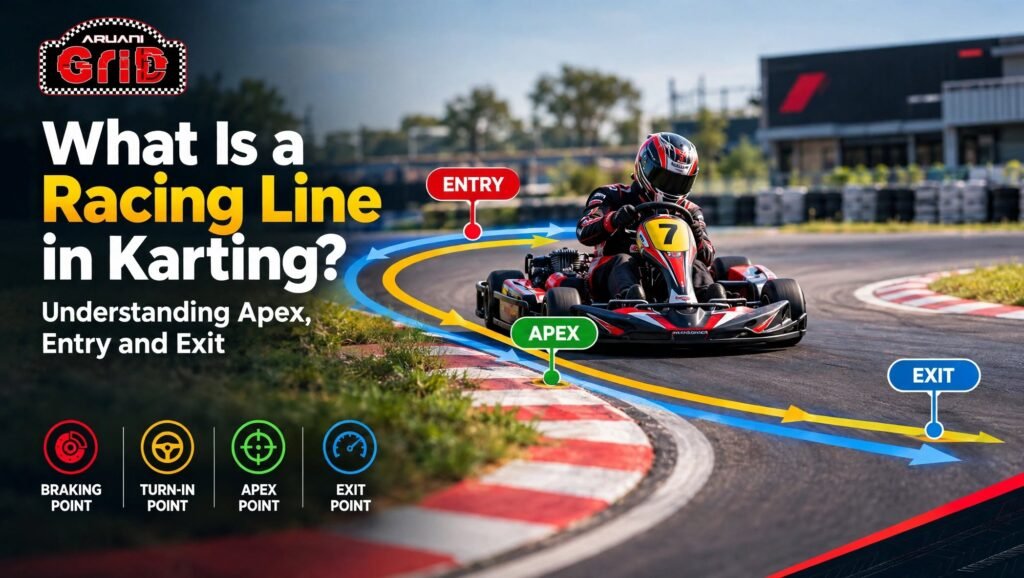
A racing line in karting is the path a go-kart follows through a corner to maintain control, carry appropriate speed and accelerate efficiently onto the next section of track. Learning the racing line means understanding where to approach a corner, when to turn in, where to reach the apex and how to exit without losing unnecessary momentum.
For beginners, mastering this technique is more valuable than simply trying to drive faster. Smooth steering, consistent braking and well-timed acceleration help make laps more controlled and repeatable. Whether you are driving a rental kart or developing your skills for competitive motorsports, understanding the racing line gives you a practical foundation for improvement.
What Is a Racing Line in Karting?
The racing line is the route a driver chooses through a circuit to achieve an efficient lap. On many corners, this involves approaching from the outside, turning towards the inside of the bend and allowing the kart to move back towards the outside on exit.
This approach generally creates a wider turning radius than taking a tight line around the inside. A wider radius can reduce the steering required and help preserve momentum, provided the driver selects an appropriate speed and remains within the permitted track boundaries.
However, there is no single racing line that works perfectly for every corner. The ideal approach depends on the corner's shape, available track width, surface grip, kart characteristics and the direction of the next turn.
The four key reference points of a racing line
A corner can be understood through four important reference points:
-
Braking point: Where you begin slowing down for the corner, when braking is necessary.
-
Turn-in point: Where you begin steering into the bend.
-
Apex: The point where the kart passes closest to the inside of the corner.
-
Exit point: The area where you finish the turn and guide the kart towards the next section of track.
These points work together. Braking too late can compromise the turn-in, an early or poorly positioned apex can make the exit difficult, and a weak exit can reduce speed along the following straight.
How Does the Outside-Inside-Outside Racing Line Work?
The outside-inside-outside approach is a useful starting point for understanding many individual corners. It allows a driver to open up the corner, manage steering inputs and prepare for acceleration on exit.
Track diagram: The basic racing line
The following is a simplified top-down diagram of a left-hand corner. It illustrates the general concept rather than a measured or exact track layout.
                   DIRECTION OF TRAVEL
                           →

       OUTSIDE ENTRY
  ────────────────────────────────
                 \
                  \  TURN-IN
                   \
                    \       . . . . .
                     \    .           .
                      \  .   APEX      )
                       \ *             )
                        \ .           .
                         \  . . . . ./
                          \
                           \___________
                             EXIT
                         OUTSIDE TRACK

             Outside → Inside → Outside
How to read the diagram: Approach from the outside where the corner and track conditions permit, steer smoothly towards the apex, and allow the kart to open its line on exit. Do not force the kart to touch a kerb or use the full track width if doing so compromises control or violates track rules.
1. Entry: Prepare before turning
Corner entry begins before the kart reaches the bend. Identify a consistent reference point, assess the corner and reduce speed as required while the kart is relatively straight.
Once the kart is at a suitable speed, begin steering smoothly towards the intended apex. Turning in too early can leave insufficient space to complete the corner, while turning in too late can result in a tight, awkward exit.
For beginners, consistency matters more than finding the absolute latest braking point. Start with a controlled approach and adjust your braking and turn-in points gradually under safe conditions.
2. Apex: Position the kart through the corner
The apex is the point where the kart passes closest to the inside of a corner. It is often called the clipping point.
A well-positioned apex helps determine how the kart travels through the rest of the turn. Reaching the apex too early may leave the kart running wide on exit. Reaching it too late may result in an unnecessarily tight line or a compromised transition into the next corner.
The objective is not simply to get as close as possible to the inside edge. It is to position the kart so that the entire corner can be completed smoothly and efficiently.
3. Exit: Prioritise a clean, controlled acceleration
The corner exit determines how effectively the kart can accelerate onto the next section of track. As the steering begins to unwind, apply throttle progressively when the kart is stable and the available grip permits it.
If a corner leads onto a long straight, a good exit can be particularly important because the speed gained carries forward along that straight.
Avoid accelerating aggressively while the kart is still turning sharply or forcing the kart towards the track edge. A clean exit is more useful than an early throttle input that causes the kart to slide or run wide.
What Is the Difference Between an Early Apex, Geometric Apex and Late Apex?
An apex can occur at different positions along a corner. The correct choice depends on the corner geometry and what comes next.
| Apex type | What it means | When it may be useful |
|---|---|---|
| Geometric or middle apex | The kart reaches the inside around the middle of a relatively uniform corner. | Balanced, constant-radius turns where the entry and exit conditions are similar. |
| Early apex | The kart reaches the inside earlier than the intended reference line. | Certain linked corners or specific sequences where the following direction changes the best line. |
| Late apex | The kart reaches the inside later in the corner. | Many hairpins and corners leading onto a straight, where a more open exit supports earlier acceleration. |
A late apex is often helpful when exit speed is a priority, but it is not automatically the fastest choice for every corner. The best line depends on the complete sequence of turns, available grip and the kart's behaviour.
Diagram: Comparing early and late apexes
EARLY APEX
Entry → Turn in early → Apex early → Tight exit
                                      ↘
                               May run wide

LATE APEX
Entry → Later turn-in → Apex later → Open exit
                                        ↗
                              Better setup for straight
These simplified paths illustrate the concepts, not exact trajectories. The braking point and turn-in position should be adjusted to suit the real corner rather than copied from a generic diagram.
How to Choose a Racing Line for Different Types of Corners
Different corners require different approaches. The key is to look beyond the immediate bend and consider how it connects to the next section.
Hairpins
A hairpin is a tight corner that requires substantial direction change and usually a significant reduction in speed.
-
Approach at a controlled speed.
-
Brake before the main steering input when conditions allow.
-
Consider a later apex if the hairpin leads onto a straight.
-
Begin accelerating as the kart rotates and the steering starts to unwind.
A common mistake is entering too quickly, missing the intended apex and having to remain on the throttle or brake incorrectly through the exit.
Sweeping corners
A sweeper is a longer, flowing turn that may allow the kart to maintain more speed than a tight hairpin.
-
Look through the corner towards the exit.
-
Use smooth steering rather than repeated corrections.
-
Avoid unnecessary lifting or braking when the corner can safely be taken at a steady pace.
-
Focus on preserving momentum without exceeding the available grip.
The ideal line depends on the corner's radius and whether another turn follows immediately.
Chicanes
A chicane combines consecutive turns in opposite directions. The best line must account for both turns rather than treating the first corner as an independent manoeuvre.
-
Position the kart to create a workable approach to the second turn.
-
Avoid sacrificing the next corner just to achieve a perfect line through the first.
-
Make steering inputs smoothly and predictably.
-
Prioritise a controlled exit from the complete sequence.
A line that looks fast through the first half of a chicane may be slower overall if it leaves the kart poorly positioned for the second half.
Double-apex corners
A double-apex corner has two important inside reference points within a linked turning sequence.
-
Identify both apexes before deciding on your approach.
-
Avoid cutting tightly towards the first apex if it prevents a clean line to the second.
-
Balance entry speed against the position needed for the final exit.
-
Focus on the whole corner sequence rather than one clipping point.
The correct line depends on the precise shape of the turn and the position of the following straight or corner.
How to Apply Racing-Line Techniques at Aruani Grid
Aruani Grid features a reported 1 km asphalt circuit across a 12-acre facility. Its listed track features include a 90-degree opening corner, a U-turn, a double-apex section, a downhill chicane and a tight hairpin.
These features offer useful examples for learning how racing-line decisions change across a circuit. The following guidance is a technique framework, not a claim that a particular line or braking marker has been measured or validated for every section of the current layout.
The 90-degree opening corner
Focus on identifying a consistent approach, choosing a controlled turn-in point and looking towards the exit. Avoid turning too early simply because the inside edge is visible.
The U-turn
The tight change of direction makes entry speed and exit positioning especially important. Practise reaching a consistent apex and accelerating progressively as the kart becomes aligned with the next section.
The double-apex section
Plan both apexes as one sequence. Observe how your position at the first apex affects your ability to reach the second and exit cleanly.
The downhill chicane
Pay attention to the change in elevation and the transitions between directions. Follow the track's instructions, use smooth steering and avoid abrupt inputs that can destabilise the kart.
The tight hairpin
Concentrate on controlled braking, a suitable turn-in point and a clean exit. If the next section is a straight, evaluate whether a later apex helps the kart accelerate sooner.
For the exact racing line, braking markers and corner sequence, follow the track briefing and guidance from authorised instructors. Track conditions, kart type and session rules can affect the appropriate approach.
How to Improve Your Racing Line and Lap Consistency
Improving your racing line is a process of observation, controlled practice and repeatable technique. Changing several driving habits at once makes it difficult to understand which adjustment actually helps.
Step 1: Learn the circuit
Before focusing on speed, understand the track layout, direction of travel, corners and safety instructions. Identify where the circuit tightens, changes direction or leads onto a straight.
Step 2: Choose reference points
Look for stable visual references to help judge braking and turn-in positions. Use the same references over multiple laps rather than choosing a new point every time.
Step 3: Practise one corner at a time
Select a corner that you find difficult and focus on completing it consistently. Pay attention to the entry, apex and exit before trying to improve your overall pace.
Step 4: Use smooth steering and throttle
Sudden steering corrections and abrupt throttle inputs can disturb the kart's balance. Make deliberate inputs and allow the kart to respond before making further adjustments.
Step 5: Compare lap times and consistency
Where timing is available, compare several laps rather than relying on your single fastest lap. A repeatable pace can indicate better control and more consistent execution.
Step 6: Make one change at a time
Adjust your braking reference, turn-in point or apex position separately. Compare the results under similar conditions and retain the adjustment only if it improves control or performance.
Step 7: Seek qualified instruction
A qualified instructor can help identify errors that are difficult to recognise from the driver's seat. Structured coaching is particularly useful when learning how corner entry affects apex placement and exit speed.
Common Racing-Line Mistakes to Avoid
Turning in too early: An early turn-in can make the exit tighter and force additional steering corrections. Adjust the turn-in point to suit the full corner.
Braking too late: Late braking can lead to missed apexes, poor control and reduced exit speed. Begin with a conservative, repeatable braking reference.
Focusing only on the apex: The apex is one part of the corner, not the entire objective. Evaluate the entry and exit together.
Applying throttle too aggressively: Abrupt acceleration while the kart is still heavily loaded in the turn can compromise grip. Apply power progressively when conditions allow.
Making unnecessary steering corrections: Excessive steering can scrub speed and disturb the kart. Look ahead and aim for a smooth, controlled path.
Ignoring the next corner: A line that works for one bend may leave the kart poorly positioned for the next. Plan linked turns as a sequence.
Copying another driver's line without understanding it: Different karts, driving conditions and traffic situations can require different approaches. Observe other drivers, but assess whether their line is suitable for your circumstances.
Is the Racing Line Different in Rental Karts and Racing Karts?
The underlying principles of entry, apex and exit apply to both rental karting and competitive karting. However, the best practical approach can differ with kart performance, braking characteristics, grip, track layout and driving conditions.
| Consideration | Rental karting | Competitive karting |
|---|---|---|
| Main learning goal | Safe control and consistent cornering | Consistent execution and performance optimisation |
| Braking approach | Follow the kart and track instructions; use controlled, repeatable braking | Refine braking points according to the kart, conditions and coaching |
| Apex selection | Start with a simple, controlled line | Evaluate how each apex affects the complete corner sequence |
| Performance feedback | Focus on control and available lap timing | Use timing, observation and instructor feedback to evaluate changes |
| Traffic management | Follow overtaking rules and maintain safe spacing | Adapt the racing line to racecraft, passing opportunities and track rules |
Neither category has one universally correct line. Learn the specific kart's behaviour and follow the operator's instructions before experimenting with technique.
Frequently Asked Questions About Racing Lines in Karting
What is a racing line in karting?
A racing line is the route a go-kart follows around a circuit to maintain an efficient path through corners and support good speed on exit. It typically involves a controlled entry, an appropriate apex and a smooth exit, adjusted for the track layout and driving conditions.
What is an apex in karting?
The apex is the point where the kart passes closest to the inside of a corner. Its position affects the line through the turn and the kart's position at the exit. The best apex depends on the corner geometry and what follows.
What is the best racing line for go-karting?
For many corners, approaching from the outside, steering towards the inside apex and opening the line on exit is a useful starting point. The ideal line varies with corner shape, kart characteristics, grip, track limits and the next turn.
How do you identify the racing line on a track?
Start by studying the circuit layout and identifying the braking point, turn-in point, apex and exit. Use stable trackside references and observe how the corner connects to the next section. A qualified instructor can help confirm the appropriate line.
Is a late apex always faster?
No. A late apex can help improve the exit from a corner leading onto a straight, but it is not always the best option. Linked corners, changes in direction and the overall circuit layout can favour a different approach.
Should beginners focus on speed or the racing line first?
Beginners should focus on safe control, smooth inputs and repeatable cornering before chasing faster lap times. Learning a consistent line makes it easier to understand how braking, steering and acceleration affect performance.
Can racing-line practice improve lap times?
Consistent racing-line practice can help improve cornering efficiency and lap consistency. The result depends on the driver's starting technique, kart characteristics, track conditions and the changes made during practice; improvements are not guaranteed.
Learn Racing Technique at Aruani Grid
Understanding the racing line is an important step towards becoming a more controlled and consistent kart driver. By learning how entry, apex and exit work together, you can develop a better understanding of cornering and make more informed adjustments during practice.
Aruani Grid in Bengaluru offers a dedicated motorsports venue, while the Anitha Kholay Motorsports Academy provides training opportunities for aspiring drivers at different experience levels.
Explore Aruani Grid to learn more about the venue and visit the Anitha Kholay Motorsports Academy for information about structured motorsports training.
Always follow the track briefing, instructor guidance and session safety rules.


