
Ever wondered why racing tracks have tight hairpins, flowing curves, quick left-right combinations and sweeping bends? These differences are not random. Every corner in racing track layout design serves a purpose, from controlling speed and testing driver skill to creating overtaking opportunities and connecting one section of the circuit to the next.
Different types of go-karting track corners challenge drivers in different ways. A hairpin demands controlled braking and a clean exit, a chicane tests precision and direction changes, and a sweeping corner rewards smooth steering and momentum. Understanding these differences can help drivers make better decisions, maintain consistency and work towards faster lap times.
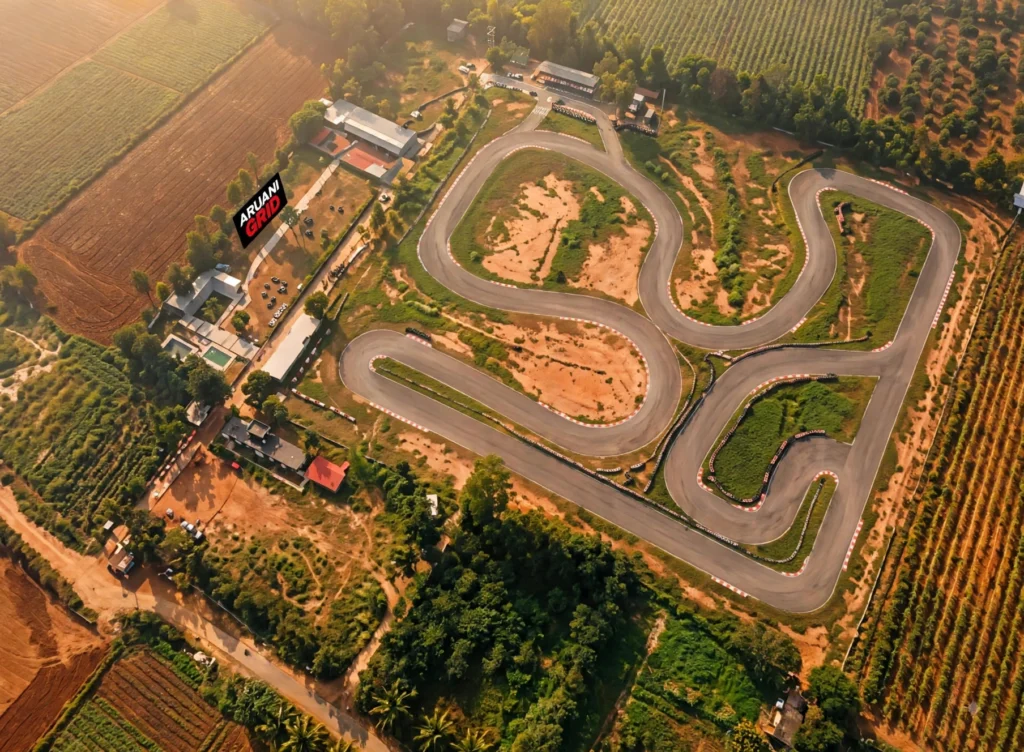
At Aruani Grid in Bengaluru, the circuit features several distinct corner configurations, making it a useful real-world example of how track design influences the driving experience.
Why Do Racing Tracks Have Different Types of Corners?
Racing tracks have different types of corners to balance speed, safety, technical difficulty, overtaking opportunities and circuit flow. Each corner changes how a driver approaches braking, steering, acceleration and vehicle positioning.
A well-designed racing circuit is not simply a collection of turns. It is a sequence of driving challenges that require different skills and decisions.
- Speed management: Tight corners and chicanes require drivers to reduce speed before navigating the turn.
- Driver skill: Different corner radii, linked turns and elevation changes test precision, timing and vehicle control.
- Overtaking opportunities: Certain corners provide better opportunities to attempt a pass, particularly when they follow a straight.
- Lap-time optimization: Corners determine how effectively drivers carry speed into the next section and accelerate onto a straight.
- Circuit flow: Combining slow, medium-speed and fast corners creates variety and challenges drivers to adapt throughout the lap.
The goal is not simply to drive faster. It is to choose the right approach for each corner while maintaining control and preparing for the next section.
What Are the Different Types of Racing Corners?
The main types of racing corners include hairpins, 90-degree turns, chicanes, sweepers, esses, double-apex corners and increasing- or decreasing-radius turns. Each has a different shape and requires a different balance of braking, steering and acceleration.
1. Hairpin Turns: Tight Corners That Demand Precision
A hairpin is a tight corner that changes direction sharply, often approaching a 180-degree turn. Hairpins typically require significant speed reduction and careful positioning before the driver can accelerate out of the corner.
Why do racing tracks have hairpins?
Hairpins help manage speed, create technical driving challenges and can provide overtaking opportunities when they follow a straight.
What makes hairpins challenging?
- Braking too late can make it difficult to turn smoothly.
- Entering too quickly can push the kart wide.
- Turning too sharply can disrupt momentum.
- Accelerating before the kart is properly positioned can compromise the exit.
How should a go-kart driver approach a hairpin?
Look ahead, reduce speed before turning, choose a controlled line and focus on a clean exit. A later apex may help when the corner leads onto a straight because it can allow the kart to straighten earlier before acceleration.
The best racing line depends on the corner radius, track layout and what follows the turn.
2. 90-Degree Corners: Balancing Speed and Control
A 90-degree corner changes direction by approximately a quarter turn. These corners are common on racing circuits and can range from relatively fast bends to slow, tight turns depending on their radius and approach.
Why are 90-degree corners important?
They test whether drivers can maintain an appropriate speed while positioning the kart correctly for the next section.
A 90-degree corner leading onto a long straight may require a different strategy from one immediately followed by another turn. In the first case, exit speed is especially important. In the second, the driver may need to prioritize the upcoming corner.
The key is to avoid treating every right-angle turn identically. Track width, grip, corner radius and the sequence of turns all influence the ideal approach.
3. Chicanes: Quick Changes of Direction
A chicane is a sequence of closely connected turns in opposite directions, such as left-right or right-left. Chicanes force drivers to change direction quickly and manage speed and positioning through the entire sequence.
Why do racing tracks include chicanes?
Chicanes introduce technical complexity, manage speed in selected sections and test a driver’s ability to connect one corner to another without unnecessary steering corrections.
The first turn affects the second. Entering the first part too aggressively can leave the kart poorly positioned for the next turn.
To navigate a chicane more effectively:
- Look through the entire sequence rather than focusing only on the first turn.
- Adjust speed before the direction changes.
- Position the kart to prepare for the next corner.
- Use smooth, controlled steering rather than sudden corrections.
- Follow the track’s safety guidance and avoid aggressive kerb use.
A smooth line through the complete chicane is often more effective than maximizing speed through its first half.
4. Sweepers: Corners That Reward Momentum
A sweeper is a long, flowing corner that allows a vehicle to maintain relatively high speed compared with a tight hairpin, depending on the corner radius and track conditions.
Why do circuits use sweeping corners?
Sweepers test a driver’s ability to maintain momentum, judge available grip and make smooth steering inputs over a sustained turn.
Unlike a tight hairpin, a sweeper may require little braking or only a small reduction in throttle. The correct approach depends on the kart, corner radius, available grip and entry speed.
The main lesson is to avoid unnecessary steering corrections. Smooth inputs help maintain a stable line, while excessive speed can push the kart wide and compromise the exit.
5. Esses: Linked S-Curves That Test Rhythm
An esses section consists of alternating corners that form an S-shaped sequence. The direction changes repeatedly, so each turn influences the positioning and speed available for the next.
Why are esses challenging?
A mistake in the first corner can compromise the entire sequence. Drivers must anticipate the next direction change rather than optimize every turn independently.
Important skills for navigating esses include:
- Looking ahead through the sequence.
- Keeping steering inputs smooth.
- Choosing a line that prepares the kart for the following corner.
- Avoiding unnecessary acceleration or braking corrections.
- Maintaining a consistent rhythm without sacrificing control.
In a linked sequence, setting up the final turn can be more important than producing the highest speed in the first corner.
6. Double-Apex Corners: Two Turning Points, One Strategy
A double-apex corner has two distinct points where the racing line approaches the inside of the turn. Instead of treating the corner as two unrelated bends, drivers often need to manage it as one continuous sequence.
Why are double-apex corners used?
They create a more complex driving challenge involving line selection, steering control, momentum and the relationship between the first and second parts of the turn.
The driver must judge where to position the kart after the first apex so that the second part remains manageable.
A common mistake is to focus entirely on the first apex and run too wide or enter the second part at an awkward angle. Looking ahead and maintaining a smooth arc can help preserve momentum.
The ideal line depends on the corner’s geometry. Not every double-apex configuration should be driven in exactly the same way.
7. Increasing-Radius and Decreasing-Radius Corners
Corner radius describes how tight or broad a turn is. An increasing-radius corner gradually opens up, while a decreasing-radius corner becomes tighter as the driver progresses through it.
Increasing-radius corners may allow drivers to carry speed or progressively accelerate as the available space opens up, provided the exit and grip permit it.
Decreasing-radius corners demand greater caution because a line that feels comfortable at entry may become too wide as the turn tightens.
The important difference is how the corner changes, not simply how much direction the kart needs to change.
Drivers should assess the complete corner, avoid committing to excessive entry speed and make sure they can manage the tightest part without losing control.
How Does Track Layout Design Affect Lap Times?
Track layout design affects lap times by determining where drivers must brake, how much speed they can carry through corners, and how effectively they can accelerate into the following sections.
Two tracks with similar lengths can feel completely different because their corner combinations demand different techniques.
| Track Feature | Main Driving Challenge | Important Consideration |
|---|---|---|
| Long straight followed by a hairpin | Braking and corner entry | Reduce speed in time and prepare for a clean exit. |
| 90-degree turn before a straight | Exit speed | Prioritize a line that supports acceleration. |
| Fast chicane | Direction changes | Position the kart for the entire sequence. |
| Long sweeper | Maintaining momentum | Use smooth steering and manage grip. |
| Esses section | Rhythm and positioning | Think several turns ahead. |
| Double-apex corner | Continuous line selection | Connect both apexes without unnecessary corrections. |
| Decreasing-radius turn | Changing corner geometry | Leave room to manage the tightening radius. |
These are general principles rather than universal rules. Actual performance depends on the vehicle, track surface, available grip, corner geometry and what comes before and after each turn.
Why Can Corner Exit Speed Matter More Than Entry Speed?
A corner’s exit can have a major influence on lap time when it leads onto a long straight. A driver who enters slightly slower but exits cleanly may gain more time down the straight than someone who enters aggressively and loses momentum on the way out.
This is why racing instructors distinguish between corners that lead onto straights, corners at the end of straights and intermediate corners.
The relationship between corners matters as much as the shape of an individual turn. Optimizing one corner without considering the next can make the overall lap slower.
How Do Racing Corners Affect Grip and Weight Transfer?
Racing corners change the forces acting on a vehicle and the way its tyres maintain contact with the track. During cornering, the vehicle experiences lateral acceleration, and its load distribution changes as the driver brakes, turns and accelerates.
Weight transfer is the redistribution of load across the vehicle as its speed or direction changes. Abrupt inputs can disturb the kart’s balance, while smooth and controlled inputs generally make it easier to maintain a consistent line.
Several factors influence cornering performance:
- Corner radius: Tighter turns generally require lower speeds than broader turns under comparable conditions.
- Speed: Higher speeds increase the demands on available grip.
- Braking: Braking changes the vehicle’s load distribution and must be managed according to the vehicle and corner.
- Steering: Excessive or abrupt steering can reduce efficiency and cause the kart to run wide.
- Track surface: Surface condition, contamination and tyre condition influence available grip.
- Elevation: Uphill and downhill sections can change braking references, visibility and vehicle loading.
In a go-kart, these factors are especially noticeable because the driver must coordinate braking, steering and acceleration with limited time to correct mistakes.
The objective is not to use the maximum possible input at every moment. It is to use the right input at the right time while staying within the available grip.
What Is the Racing Line, and Why Does It Change Between Corners?
The racing line is the path a driver chooses through a corner or sequence of corners to balance entry speed, cornering performance and exit speed. It often uses the available track width to create a smoother path, but the ideal line depends on the corner and the next section of the circuit.
Three common apex approaches are:
- Early apex: The driver reaches the inside of the corner relatively early. This can leave the vehicle running wide on exit if the approach is unsuitable.
- Geometric or middle apex: The driver follows a line that reaches the inside around the middle of the corner.
- Late apex: The driver reaches the inside later, often helping position the vehicle for a stronger exit onto a straight.
A late apex is not automatically the fastest option for every corner. A flowing bend, a linked chicane and a tight hairpin may require different approaches.
For beginners, consistency is more valuable than copying a racing line without understanding why it works. Follow the circuit’s rules, respect other drivers and avoid sudden changes of direction.
How Aruani Grid’s Track Layout Brings These Concepts to Life
Aruani Grid, located along Sarjapur Road near Dommasandra in Bengaluru, offers a practical setting for experiencing how different corner configurations influence go-karting.
The venue’s main asphalt circuit spans just over one kilometre and includes several distinct features.
A 90-Degree Opening Left-Hander
The opening corner introduces a change in direction that requires the driver to judge the approach, manage speed and establish a suitable line for the section that follows.
A U-Turn
The U-turn provides an opportunity to practise controlled corner entry, accurate positioning and a clean exit rather than carrying excessive speed into a tight turn.
A Right-Hand Double-Apex Section
This configuration highlights the importance of connecting two turning points and thinking about the corner as a sequence rather than two isolated actions.
A Downhill Chicane
The downhill chicane combines direction changes with an elevation change. Drivers must pay attention to their braking references, positioning and the complete sequence of turns. The correct approach depends on conditions and the kart being driven.
A Fast Double-Apex Section Leading to a Tight Right-Hand Hairpin
This part of the layout creates a contrast between a faster sequence and a tighter corner. It reinforces the importance of adjusting driving technique as the track changes character.
Together, these features demonstrate why a circuit needs more than one type of corner to test a driver’s ability. Each section creates a different challenge involving speed, positioning, steering and preparation for the next turn.
Aruani Grid also offers karting experiences for recreational drivers and higher-performance options for eligible advanced training. Confirm current kart availability, operating conditions and session details directly with the venue.
How Can Beginners Improve Their Cornering Skills in Go-Karting?
Beginners can improve cornering by focusing on observation, consistency, smooth inputs and a clear understanding of what comes after each turn.
- Look ahead: Keep your attention on the path through the corner and the section beyond it. Looking only at the track immediately in front of the kart can make it harder to prepare for the next turn.
- Identify the corner type: Recognize whether you are approaching a hairpin, chicane, sweeper or linked sequence. This helps you anticipate the positioning and speed management required.
- Brake smoothly where needed: Use the kart’s braking system according to the instructions provided by the venue. Avoid abrupt inputs and do not assume every corner requires the same braking point.
- Focus on a repeatable line: Choose a controlled line that suits the corner and conditions. Repeating a safe, consistent approach helps you identify where your technique needs improvement.
- Avoid unnecessary steering corrections: Sudden steering movements can disturb the kart’s balance. Aim for smooth, deliberate inputs while staying within the designated track boundaries.
- Prepare for the next corner: In a chicane or esses section, think about how your position in the current corner affects the next one.
- Improve consistency before chasing speed: Work on completing several controlled laps with similar lines and inputs. With guidance from a qualified instructor, assess opportunities to improve your lap times.
Always follow venue safety instructions, use the required protective equipment and respect the limits of your experience.
Common Mistakes Drivers Make When Taking Racing Corners
| Common Mistake | Why It Can Be a Problem | Better Approach |
|---|---|---|
| Entering too fast | The kart may run wide or require corrective inputs. | Adjust speed to suit the corner and available grip. |
| Focusing only on the first turn | The next corner may become difficult to position for. | Look through linked sequences. |
| Turning too abruptly | Sudden inputs can upset the kart’s balance. | Use controlled steering. |
| Ignoring exit speed | Poor positioning may compromise acceleration onto a straight. | Consider what follows the corner. |
| Copying another driver’s line blindly | Different approaches may reflect different conditions or mistakes. | Understand the purpose of your line. |
| Chasing a faster lap too early | Inconsistent inputs make progress difficult to measure. | Build control and repeatability first. |
The key lesson is simple: a good lap is built from a sequence of well-managed corners, not one spectacular turn.
Frequently Asked Questions About Racing Track Corners
What are the main types of corners in racing?
Common racing-corner types include hairpins, 90-degree turns, chicanes, sweepers, esses, double-apex corners and increasing- or decreasing-radius turns. Each has a different geometry and creates distinct challenges involving speed, steering, grip and positioning.
Why do racing tracks have hairpin turns?
Hairpins help manage speed and create technical challenges that test braking, corner entry and exit control. When a hairpin follows a straight, the braking zone can also create an opportunity for overtaking, depending on the circuit and racing conditions.
What is a chicane in motorsport?
A chicane is a sequence of connected corners in opposite directions, usually left-right or right-left. It tests how effectively a driver can manage speed and position the vehicle through multiple direction changes without compromising the entire sequence.
What is a double-apex corner?
A double-apex corner has two distinct apex points along the driving line. Drivers must coordinate their position and steering through both parts of the turn, balancing momentum and the best line for the corner’s overall geometry.
Which corner type is the hardest in go-karting?
There is no universally hardest corner type. Tight hairpins challenge braking and exit control, chicanes test quick direction changes, and decreasing-radius corners demand careful speed management. Difficulty depends on the track layout, kart, surface and driver’s experience.
How does track layout affect go-kart lap times?
Track layout determines where drivers need to reduce speed, how they position the kart and how quickly they can accelerate into the next section. A clean exit onto a straight can be more important than entering a corner at the highest possible speed.
Can beginners learn racing lines at a go-karting track?
Yes. Beginners can develop an understanding of racing lines by learning to look ahead, recognize corner types, use smooth inputs and maintain consistent positioning. They should follow venue safety instructions and seek qualified guidance when available.
Where can I experience different racing-corner types in Bengaluru?
Aruani Grid is a motorsport and go-karting venue on Sarjapur Road near Dommasandra, Bengaluru. Its main circuit includes a 90-degree opening corner, a U-turn, a double-apex section, a downhill chicane and a tight hairpin. Check directly with the venue for current operating details, kart options and booking availability.
Conclusion: Better Cornering Starts With Understanding the Track
Different types of racing corners exist because every turn changes the demands placed on a driver. Hairpins reward controlled entry and exit, chicanes test positioning, sweepers emphasize smooth momentum, and linked corners require drivers to think ahead.
Understanding these differences helps you make better decisions, improve consistency and appreciate the engineering behind racing track layout design.
Whether you are trying go-karting for the first time or developing your driving skills, learning to read a circuit is an important step towards becoming a more confident driver.
Ready to put your cornering skills to the test? Explore the go-karting experience at Aruani Grid, Sarjapur Road, Dommasandra, Bengaluru, and discover how different corners can change every lap.
Visit the official Aruani Grid website to check current session details and booking information.


